
Why Lost Love Cannot Be Recovered
Orpheus and Eurydice: The Danger of Looking Back

Who has not, at least once, imagined getting back together with an ex? The wish is understandable: we long not only for the person we lost, but also for the past we shared with them. Yet such returns rarely succeed. The myth of Orpheus and Eurydice offers a revealing way to understand why trying to recover a lost love often leads to losing it all over again. Let us descend into Hades, then, and see why some loves cannot be brought back.
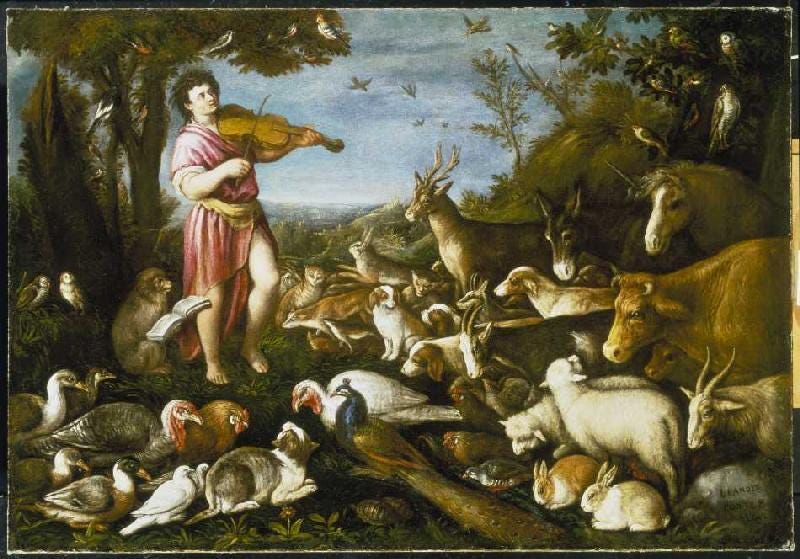
Once there was a musician named Orpheus who could play such beautiful music that even trees and animals seemed to listen.
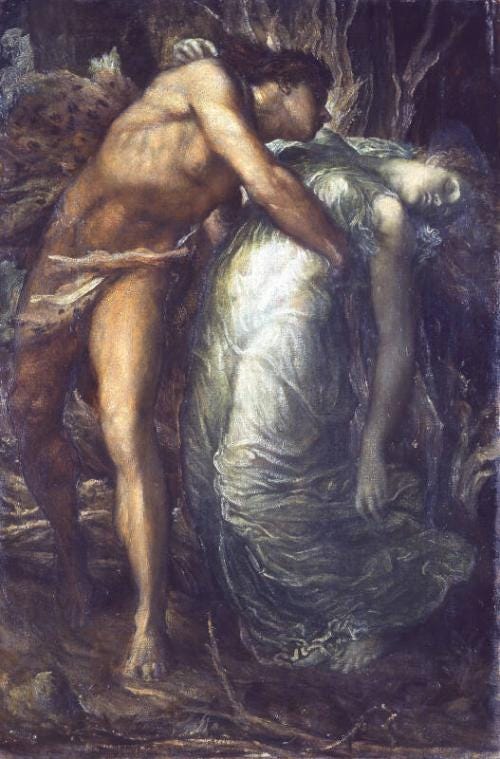
Orpheus loved his wife, Eurydice, very much. But one day Eurydice died, and Orpheus was overcome with grief.He traveled down into the Underworld, the dark land of the dead, to bring her back.
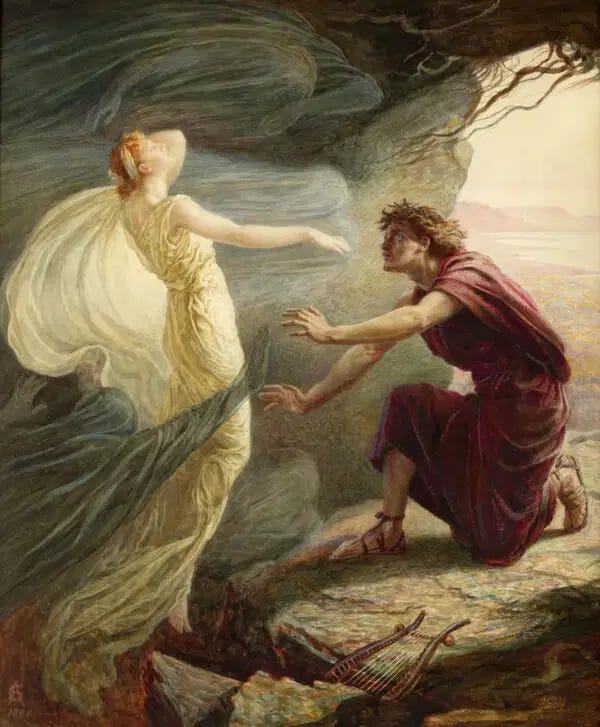
When a relationship ends and the other person is no longer part of your life, it can feel like a kind of death. It is not only the partner who is lost, but also the shared world that once existed between two people. From this perspective, Eurydice can be read not only as a dead wife, but as the symbol of someone who has irreversibly disappeared from Orpheus’s life.
Psychologically, Orpheus’s journey to the Underworld can be understood as a descent into grief and the unconscious after the loss of a loved one. His music represents the power of art and emotional expression: instead of denying his pain, he gives it a form that allows him to enter the darkest parts of himself.

He missed her so much that he decided to do something almost no one would dare do.
As Orpheus moved through that dark realm, he played his music. It was so full of sorrow and beauty that it moved all who heard it. Even the rulers of the Underworld were touched by his grief
So Orpheus was given one chance to take Eurydice home.
But there was one very important rule:
Eurydice would walk behind him, and he must not look back at her until they had both reached the world above.

Orpheus agreed and started the long climb back. He could hear nothing. He could not see her. The path was dark and quiet, and he began to worry.
What if she was not really there?
What if the rulers of the Underworld had tricked him?
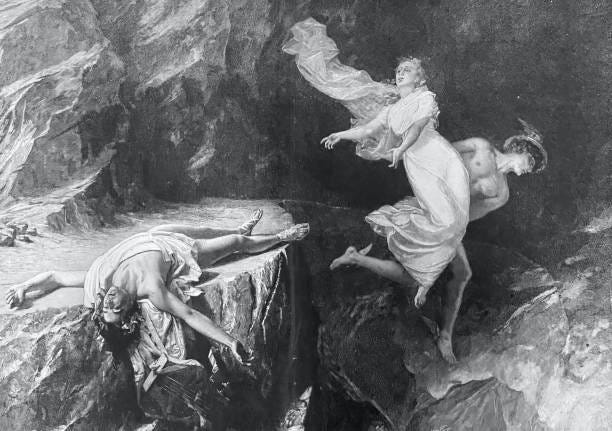
Just as he reached the top, he became afraid and turned to look.
And Eurydice vanished back into the Underworld.
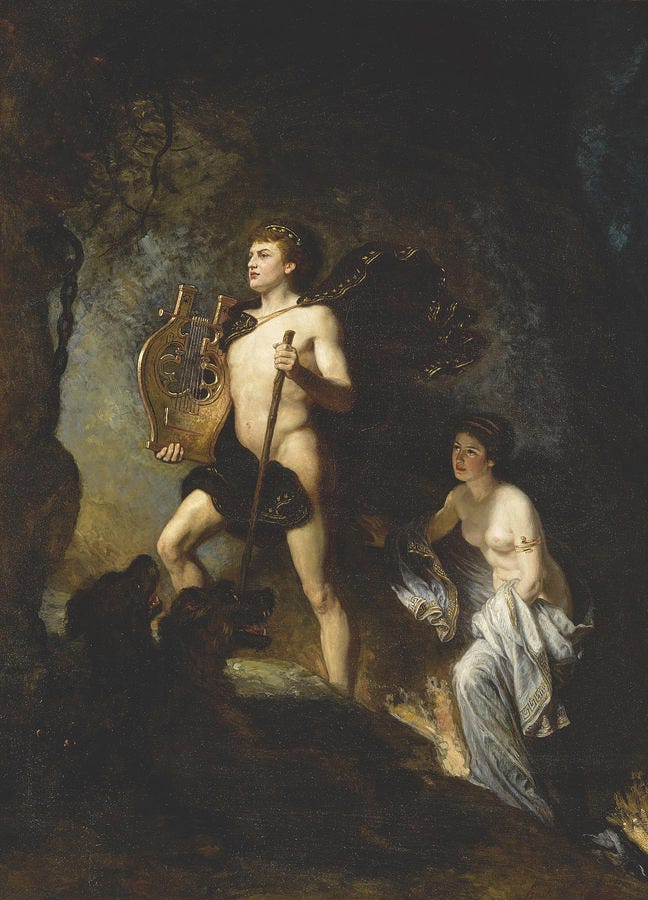
The myth of Orpheus and Eurydice can be read as a story about relationships that fail and the desire to restore them. After a separation, one person may try to get the other back by showing how much they have changed. But Orpheus’s backward glance shows how hard it is to escape old patterns. Looking back symbolizes returning to the same insecurity and emotional habits that once destroyed the bond. As a result, Eurydice is lost again, just as a relationship can be lost again when the past is repeated instead of overcome.
In many cases, the effort to change after a breakup remains only a facade. The person tries to show that they have improved, but this change is often driven less by genuine inner transformation than by the wish to win the other back. Because there is no real internal reorientation, the facade breaks down as soon as the relationship seems recovered. What returns is not a new form of love, but the same old pattern that was leading toward separation. From this perspective, Eurydice returns to Hades because nothing truly new has been created; only the old relationship is being repeated.
The mere desire to impress the other person reveals that the change often comes not from inner stability, but from neediness. Like Orpheus’s music, suffering can produce something touching, and convincing. Yet a relationship cannot be built on eloquent words and promises alone; it needs concrete action and a shared vision.
That is why the real test is not to look back: to leave Hades without any reassurance that she is still there. It means being secure enough in where you are going and in what you are trying to build. Looking back reveals an inability to let the past die and a desire to seek safety in familiar patterns rather than risk working toward something that might actually succeed in reality.
So before descending into the kingdom of Hades in search of lost love, one should at least ask why it ended up there in the first place. Many relationships appear far more beautiful in retrospect than they truly were, especially during the early, intoxicating phase when hormones play such a powerful role. Memory is selective: in moments of grief or temporary loneliness, as we rebuild our lives, we cling to the best scenes and forget the final chapter, when we were already asking ourselves who this person had become.In many cases, although not all, it is better to preserve such love as a beautiful memory that still brings a smile rather than try to revive it.
Awesome, I just posted my version of the myth a moment ago 🤭 I love it
Thank you for sharing!this is a really grounding reminder. If change is driven by the desire to win someone back, it often becomes a performance, and things tend to slip back to old patterns once the relationship resumes. People say love lasts about three months,the span of heightened chemistry,but what actually sustains a relationship is steady presence and shared vision in life, just like you said.
That said, there’s something undeniably romantic about the idea of someone willing to descend into hell for you, to play a melody that brings you back. Not everyone gets to experience something like that in a lifetime,hahahah😆😆