
Mastery Without Recognition
The Arachne Trap

Everyone has met someone like this.
A student sharper than the teacher.
An athlete who stops listening to the trainer because talent already convinced him.
An employee who looks at the boss’s decision and thinks:
I could do this better.
Maybe it is arrogance.
Maybe it is true.
That is where Arachne begins.
She had no title, no authority.
Only talent.
And that was enough to anger the goddess of wisdom.
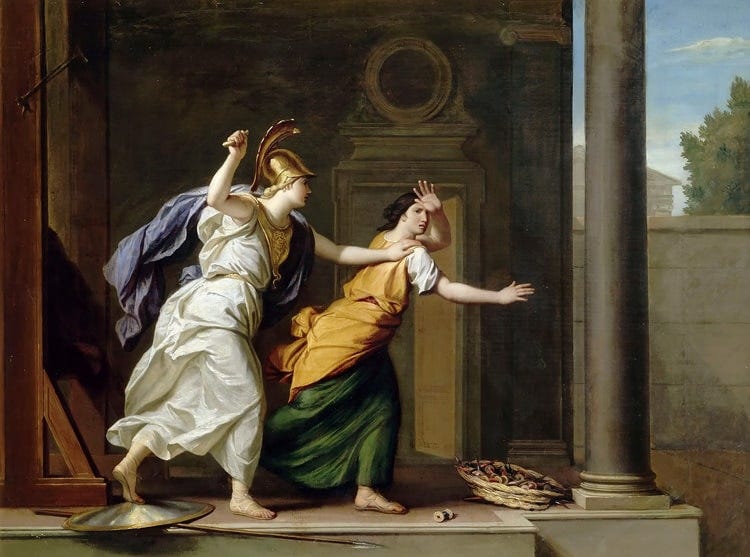
Arachne challenged the goddess to a contest of weaving.
In Ovid’s Metamorphoses, Minerva, also known as Athena, first comes disguised as an old woman.
Arachne is young, gifted, beautiful, and ambitious.
One carries divine authority and mastery.
The other carries raw talent, youth and charm.
Minerva’s tapestry shows the victories, achievements, and glory of the gods.
It presents divine power as legitimate, ordered, and worthy of respect.
Arachne’s tapestry does the opposite.
It shows the stories in which the gods misuse their power, abuse mortals, and act as hypocrites.
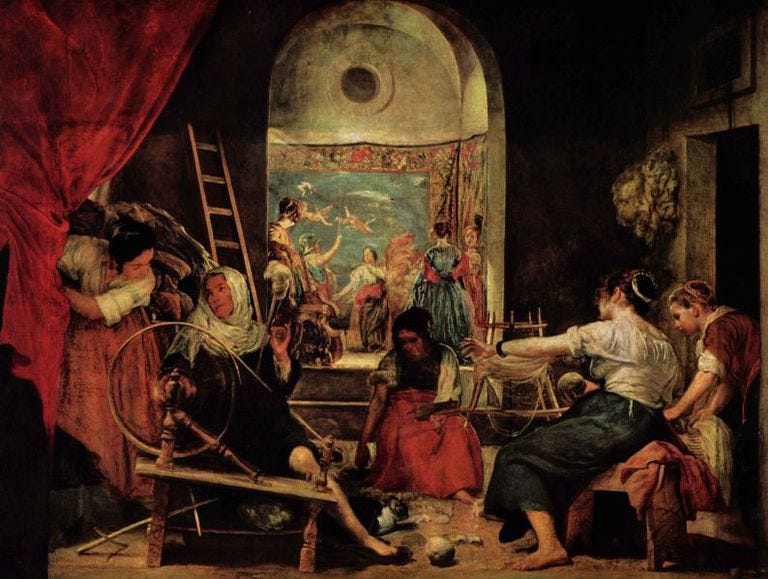
Arachne acts like the student who says schools and universities are pointless.
That everything can be learned alone.
That no institution is needed.
That no diploma, title, or official approval can prove real competence.
And sometimes this student is right.
Institutions can become arrogant.
They can confuse certificates with intelligence and prestige with truth.
But Minerva answers from the other side.
She says: look at what this institution has built.
Look at the masters who came through it.
Look at the knowledge preserved, published, tested, and passed down.
Beneath the prestige and power, there may also be real wisdom.
Real discipline.
Real competence.
Minerva cannot deny Arachne’s skill.
The work is technically perfect.
No flaw in the art.
But the images make her furious.
Arachne is given a chance to soften, to show humility, to seek a place within the order she mocks. She refuses every time.
Minerva punishes the message, not the technique.
In despair, Arachne tries to take her own life.
But Minerva does not let her disappear.
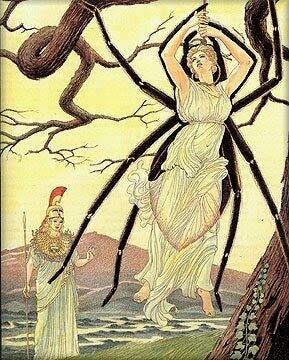
She transforms her into a spider.
From now on, Arachne will keep weaving forever.
Not as an artist with a voice, but as a creature trapped inside the work itself.
Talent becomes dangerous when it rejects all hierarchy..
Status becomes corrupt when it refuses to recognize talent
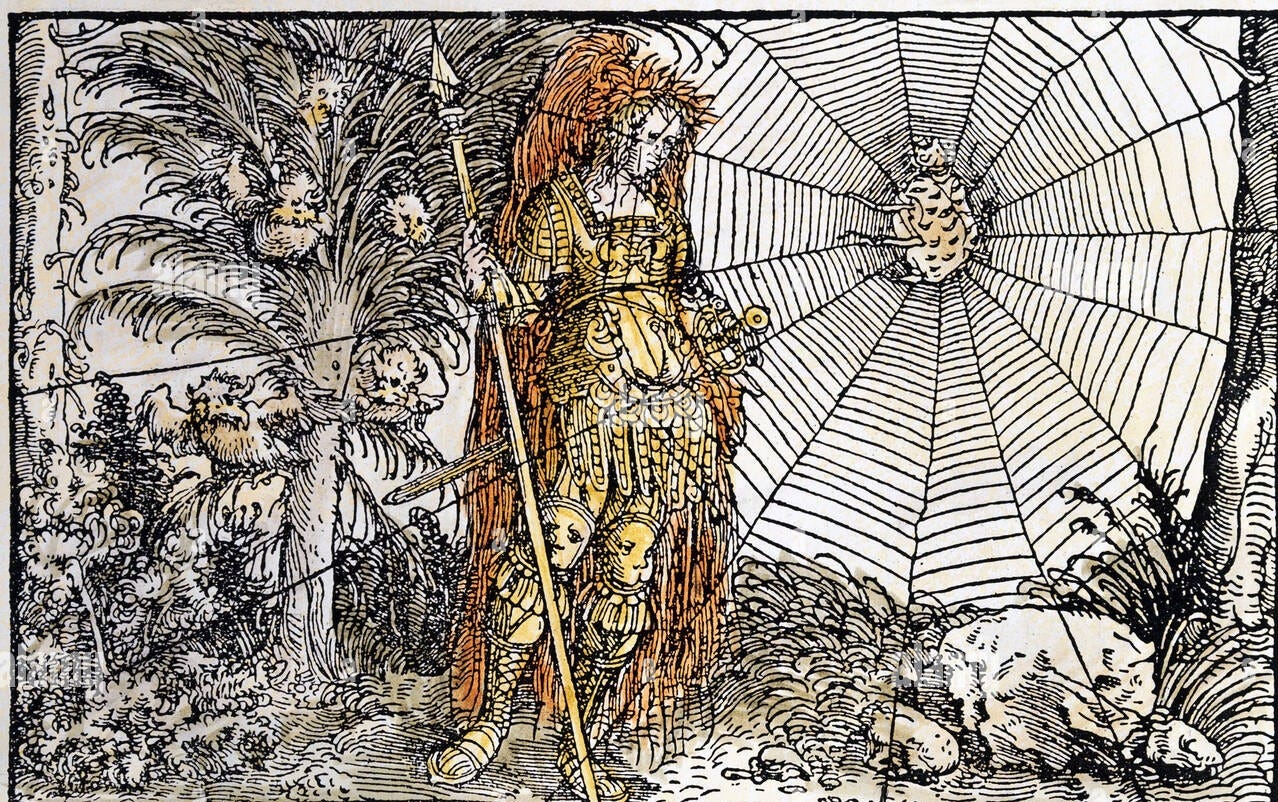
The curse of Arachne is mastery without recognition
Popular narratives love talent and genius.
They tell us that if the work is good enough, it will speak for itself.
Minerva and the other gods represent something talent often wants to reject.
Structure.
Discipline.
Tradition.
A public.
A frame around the work.
Without them, talent remains skilled, but unseen.
That is the curse of Arachne.
Mastery without recognition.
You can be a wonderful painter, but if nobody gives you a canvas, a gallery, or a name, all you may get to paint are the walls of buildings.
Not because you have no talent.
But because your talent never escapes pure skill.
The same happens in business, writing, art, and almost every field. You can be paid or hired for what your hands can do, while your name remains invisible. No brand. No prestige. No authority under your work.
You become useful, but not recognized.
Reduced to your own talent.
And slowly, like Arachne, you turn yourself into a spider.
You no longer weave to create something meaningful.
You weave nets just to survive.

I'm a sucker for the classics. I would actually discuss the classics with my grandpa when I was growing up and your work makes glad and nostalgic at the same time. I think you have an interesting set up to run the analysis from. I wonder if you used a more narrative structure and just one font if the work would land a bit more cohesively. I really like what you are doing!
Does this mean rebeledy has always existed? And people that fall in line lack own free mind? As you say, it's a trap.